
 EN
EN
 AR
AR
 HI
HI
 JA
JA
 KO
KO
 NO
NO
 RU
RU
 CA
CA
 TL
TL
 IW
IW
 ID
ID
 SR
SR
 UK
UK
 VI
VI
 SQ
SQ
 GL
GL
 MT
MT
 TH
TH
 TR
TR
 FA
FA
 AF
AF
 MS
MS
 SW
SW
 CY
CY
 IS
IS
 MK
MK
 HY
HY
 AZ
AZ
 EU
EU
 KA
KA
 HT
HT
 UR
UR
 BN
BN
 LA
LA
 MN
MN
 NE
NE
 SO
SO
 MY
MY
 KK
KK
 UZ
UZ
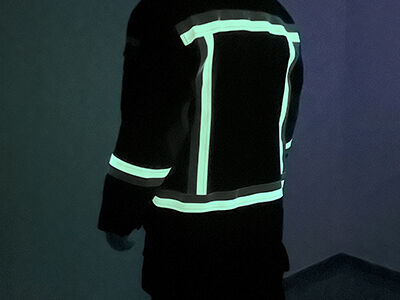
In the thick smoke and chaos of a fire ground, how do firefighters recognize each other?
In a smoke-filled corridor with power cut off, how do trapped victims find their way to safety? The subtle stripes on a firefighter's turnout gear-reflective tape and photoluminescent tape-often provide the critical guidance. They are the "lifesaving signals" for firefighters in low-visibility environments and an indispensable safety element in modern firefighting equipment.
Firefighter Reflective Tape: The "High-Intensity Signal" on the Fire ground
Reflective materials work by directing incident light back toward its source along the original path.This means they require a continuous external light source to function. When illuminated, reflective materials light up instantly, offering high visibility from a distance, enhancing safety and conspicuity.
The Reflective tapes used on firefighter gear undergo specialized flame -retardant and heat-resistant treatment. The current industry standard, and the very material ATI-FIRE incorporates into its gear,is the 3M™ Scotchlite™ Flame Retardant Reflective Film. This reflective tape complies with the strict flammability requirements of EN 469. It does not melt or drip when exposed to flame, will not continue to burn, and maintains its structural integrity even at temperatures as high as 260℃, making it suitable for rescue operations in virtually all scenarios.
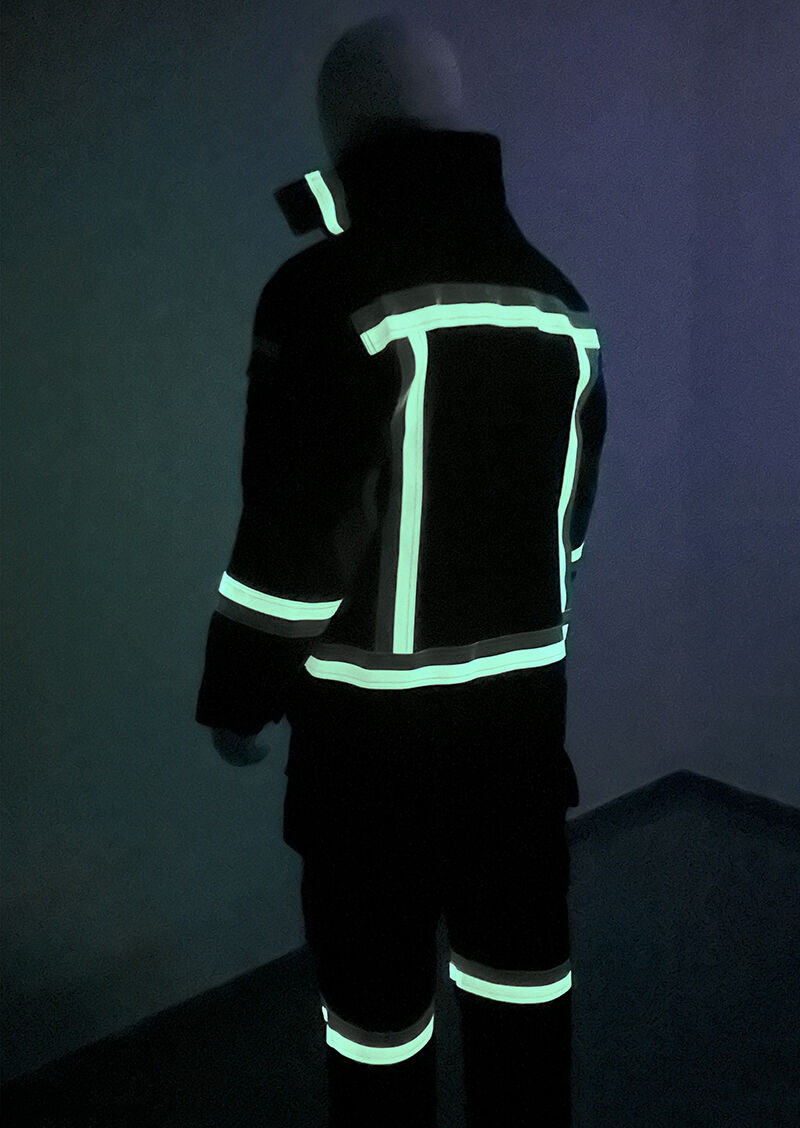
Firefighter Photoluminescent Tape: The "Continuous Guide" in Darkness
Reflective materials shine brightly only when a light source directly hits them. From other angles, they appear as ordinary fabric and do not emit light. Photoluminescent materials(which also known as luminous tape), however, absorb and store light energy. Their core component—rare-earth-doped aluminates—undergoes a process where electrons within the material are excited by visible or ultraviolet light trapping that energy. When the light source is removed, the electrons slowly return to their ground state, releasing the stored energy as visible light. This creates a slow-release glow in darkness, forming a visible afterglow.
It is crucial to note that the brightness of this afterglow decays over time; it is not a permanent self-illumination. Furthermore, these materials do not visibly glow while actively being lit. In firefighting, photoluminescent tape is primarily used in environments with a complete power failure, such a enclosed spaces, and for marking escape route signage.
Comparative Overview
| Material | Working Principle | Characteristics | Application |
| Reflective Material |
"Borrows light to shine" (reflects incident light back to its source) |
Requires external light sourceInstantaneous high visibility | Most firefighting scenarios |
| Photoluminesc-ent Material |
"Stores energy to glow" (absorbs and stores light energy, then releases it slowly in darkness) |
Invisible under direct lightstores energyprovides continuous glow in darkness | Completely dark environment |
Conclusion
Reflective and photoluminescent tapes serve distinct and vital functions in firefighting scenarios. When equipping a fire crew, the primary operational environment should guide the choice:
• For primarily nighttime outdoor operations where vehicle or portable lights are present, high-grade reflective materials should be the priority.
• For situations where entry into completely dark spaces without any light source, photoluminescent materials are better.
ATI-FIRE is dedicated to providing global firefighters with equipment solutions that meet the highest standards. We offer high-quality turnout gear equipped with premium reflective and photoluminescent tapes. Through continuous innovation, we are also developing composite materials that integrate both reflective and photoluminescent properties, ensuring our gear remains a trustworthy "Guardian of Light" in any extreme environment.