
In international firefighting standards, EN 469 and NFPA are two widely recognised and referenced systems. However, when procurement decisions are made without a deep understanding of these standards, inaccurate conclusions can follow. For example: do you know what X1/Y1/Z1 and X2/Y2/Z2 actually represent in EN 469?
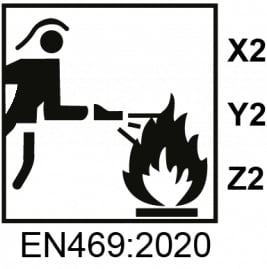
X2/Y2/Z2 represents the highest performance levels under the latest version of the European firefighter protective clothing standard, EN 469:2020. Many suppliers and online resources describe X, Y and Z as “flame heat”, “radiant heat” and “convective heat” respectively. That is not accurate. In the formal EN 469:2020 framework, X corresponds to heat transfer performance under the combined action of flame and radiant heat; Y corresponds to resistance to liquid water penetration (water resistance); and Z corresponds to water vapour resistance — that is, breathability and moisture vapour removal. Misreading Y and Z as two types of heat transfer leads to a fundamental misunderstanding of how the garment’s performance logic works. Together, the three form a complete microclimate management system and reflect how long a firefighter can sustain high-intensity work in the garment without being overcome by their own body heat.
X2: Blocking “heat from outside” — more than simply “burn resistance”
X2 is the highest performance level in EN 469:2020 for the heat protection dimension, but it does not measure “never burning through.” It measures the time required, under standard test conditions, for heat to transfer to the skin and cause a second-degree burn — in other words, the safe reaction time a firefighter protective garment provides when exposed to high-temperature flames.
EN 469 defines two levels, X1 and X2.
X1: After the skin reaches the pain threshold under flame exposure, at least 3 seconds remain before a second-degree burn occurs (based on a skin temperature rise of 24°C). The total protection time from flame contact to second-degree burn is at least 9 seconds.
X2: HTI₂₄ – HTI₁₂ — the time from pain threshold to second-degree burn under flame exposure — must be at least 4 seconds. HTI₂₄ — the total protection time from flame contact to second-degree burn — must be at least 13 seconds.
The extra 4 seconds under X2 can become a critical buffer in sudden flashover or flash fire events — the time between a firefighter feeling burning pain and the moment they must immediately withdraw. It provides more time to complete the brain’s reaction, turn and evacuate, or call out to colleagues to retreat.
EN 469:2020 also adds a contact heat test to X2: the garment must withstand contact heat at 250°C for at least 10 seconds. This means X2 no longer assesses only flame and radiant heat; it also brings into the evaluation the real-world scenario in which a firefighter’s knees or shoulders briefly contact hot surfaces during interior fire attack. X2 is therefore rated as providing “longer protection under flame exposure.” Its purpose is to protect the time window a firefighter needs to react correctly in an extreme heat event — not to promise that a garment allows unlimited exposure to a fire environment.
Y2: Keeping “water from outside” out — a true barrier layer is required
The standard wording for Y2 is “resistance to hydrostatic pressure ≥ 20 kPa” (approximately a 2-metre water column). But behind this short definition is a non-negotiable structural requirement: Y2 garments must include a continuous moisture barrier.
Without a moisture barrier, a garment can only achieve Y1 even if its outer fabric has a water-repellent finish. A water-repellent finish makes water bead on the surface, but once the fabric’s pore structure is saturated, liquid water will pass straight through. The moisture barrier required for Y2 performs the “impenetrable” role: it is a functional membrane or coating, and the seams must also be sealed so that the entire garment — including seams — shows no liquid water penetration at 20 kPa hydrostatic pressure. Y2 therefore enhances protection against high-pressure water and steam scalding compared with Y1. Both are common liquid-water hazards in firefighting, not exceptions that can be ignored.
Z2: Letting “trapped water vapour” out — the indicator most closely tied to “can I keep working?”
Z2 measures water vapour resistance — the ability of firefighter protective clothing to release sweat vapour — expressed as the Ret value. The lower the value, the more easily water vapour can escape from inside the garment. In EN 469:2020, the thresholds for Z1 and Z2 are:
Z1: Ret > 30 m²·Pa/W
Z2: Ret ≤ 30 m²·Pa/W
Many people assume that Z2 is merely a “more comfortable” bonus feature. In reality, it is directly related to firefighter safety and is a key defence against heat stress. Firefighters sweat heavily during high-intensity firefighting. If the garment has poor moisture vapour removal, water vapour becomes trapped inside the protective clothing and sweat cannot evaporate to cool the body. Even if the outer layer blocks flames, core body temperature will continue to rise. This can lead to heat exhaustion, rapid physical fatigue and, in extreme cases, life-threatening conditions. Z2 therefore protects the sweat evaporation pathway; it does not directly “block convective heat,” as some suppliers or resources claim.
X2/Y2/Z2 together: a complete heat stress solution
The EN 469:2020 X2/Y2/Z2 combination is a balanced design logic covering heat protection, liquid water resistance and water vapour removal. Looking at any one item in isolation can easily lead to a one-sided conclusion. A garment with high X2 but poor Z2 may perform well in short-term extreme exposure, yet leave the firefighter heated from the inside by their own sweat during sustained work. A combination with strong Y2 but weak Z2 achieves water resistance at the cost of losing control of the internal microclimate. EN 469:2020’s parallel labelling of X, Y and Z is itself a statement: heat protection, liquid water resistance and water vapour removal are three mutually constrained dimensions that must hold true simultaneously on the same garment.
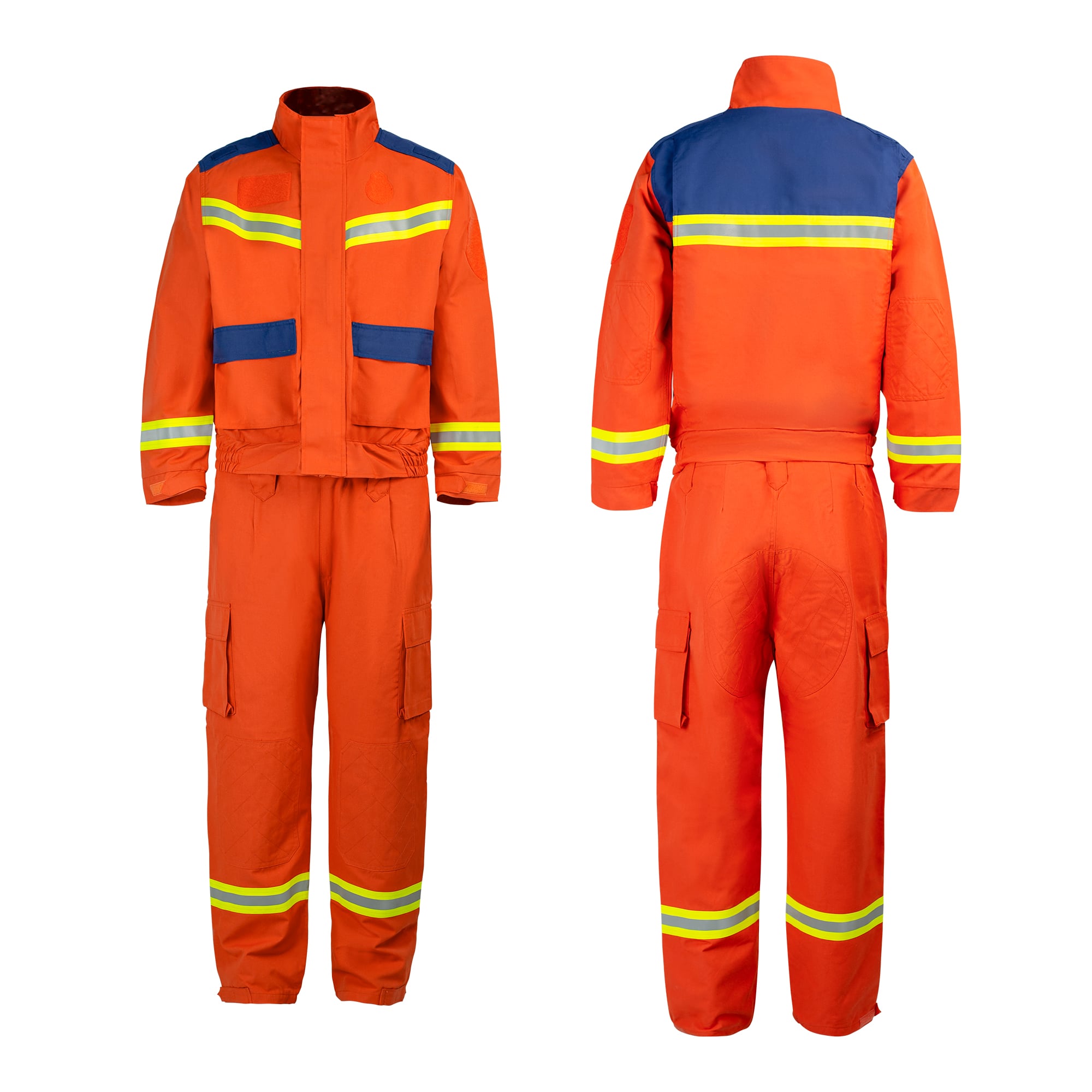
As an international manufacturer and supplier of firefighter personal protective equipment, ATI-FIRE is committed to high quality standards. We manufacture strictly to the highest EN 469:2020 performance levels — X2/Y2/Z2 — ensuring that every firefighter garment we supply can withstand the threefold scrutiny of EN 469:2020 X2, Y2 and Z2. If you are evaluating EN 469:2020 Level 2 equipment for your department, please contact us for product-specific performance data, certificate and configuration options.

ATI-FIRE professional firefighting PPE factory Full-scenario firefighting equipment system, using cutting-edge technology to build a lifeline.
No. 45, Lianhuashan Avenue, Hecun Town, Jiangshan City, Quzhou, Zhejiang, China 324100
Copyright © Jiangshan Ati-Fire Technology Co., Ltd. All Rights Reserved Privacy Policy

 EN
 AR
 HI
 JA
 KO
 NO
 RU
 CA
 TL
 IW
 ID
 SR
 UK
 VI
 SQ
 GL
 MT
 TH
 TR
 FA
 AF
 MS
 SW
 CY
 IS
 MK
 HY
 AZ
 EU
 KA
 HT
 UR
 BN
 LA
 MN
 NE
 SO
 MY
 KK
 UZ

 Hot News